
STEAM Education: Transforming Students Into Future-Ready Innovators
Discover how STEAM Education (Science, Technology, Engineering, Arts & Mathematics) builds creativity, critical thinking, innovation skills and prepares students for the future.
The world is changing faster than ever—driven by technology, creativity, automation and innovation. To prepare students for this future, education must go beyond textbooks and memorization. This is where STEAM Education plays a powerful role. By combining Science, Technology, Engineering, Arts and Mathematics, STEAM offers a learning experience that is hands-on, future-focused and deeply engaging.
What Is STEAM Education?
STEAM is an interdisciplinary learning approach that connects five core subjects—Science, Technology, Engineering, Arts and Mathematics—to help students understand how knowledge is used in real life.
Instead of teaching subjects in isolation, STEAM blends them together to build:
- Creativity
- Logical reasoning
- Critical thinking
- Practical problem-solving
- Innovative mindset
It encourages students to ask questions, explore possibilities and think beyond traditional boundaries.
Why STEAM Matters in Today’s World
Modern careers demand more than academic knowledge. Employers are now looking for individuals who can:
- Think critically
- Analyze problems
- Collaborate in teams
- Design creative solutions
- Use technology confidently
STEAM builds exactly these skills.
By the time today’s students graduate, many future jobs will be related to robotics, AI, data science, design technology, biotechnology and more. STEAM prepares them to excel in such fields.
How STEAM Differs From Traditional Learning
Traditional education focuses mainly on theory, memorization and textbook learning.
In contrast, STEAM emphasizes:
1. Project-Based Learning
Students work on real-world projects that require research, planning, designing and presenting solutions.
2. Hands-On Experiments
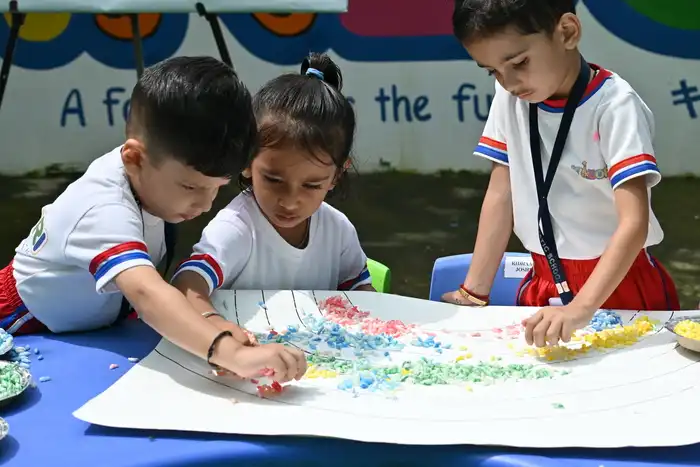
From building models to designing prototypes, students learn by doing—not just reading.
3. Creativity Through Arts
Adding ‘A’ (Arts) brings imagination, design thinking, expressions and innovation to technical subjects.
4. Collaborative Learning
STEAM encourages teamwork—helping children build communication, leadership and social skills.
5. Real-World Application
Students connect classroom concepts with real-life challenges, making learning meaningful and engaging.
Benefits of STEAM Education
1. Boosts Creativity and Imagination
Arts integrated with science and technology helps students think differently and design creative solutions.
2. Develops Critical Thinking
Students learn to analyse, question, evaluate and make logical decisions.
3. Builds Confidence
Hands-on projects help children express ideas freely and confidently.
4. Encourages Innovation
Students experiment, fail, learn, and improve—just like real innovators do.
5. Prepares for Future Careers
STEAM builds the foundation for careers in engineering, AI, robotics, architecture, medical research, coding, game design and more.
6. Improves Problem-Solving Abilities
Students learn to identify problems, research solutions and implement ideas.
Examples of STEAM Learning Activities
- Building simple machines
- Robotics and coding workshops
- Designing models or structures
- Science experiments
- 3D printing projects
- Digital art creation
- Mathematics-based games
- Engineering challenges
Such activities make learning fun, interactive and impactful.
Conclusion
STEAM Education is not just a teaching method; it is a powerful tool that prepares students for tomorrow. By combining creativity with technology and innovation, STEAM helps children develop the mindset and skills needed to succeed in a rapidly changing world.
Schools that adopt STEAM learning empower students to become thinkers, creators and future-ready leaders.

Related Articles
Pre-Nursery Admission Age vs Nursery Admission: What Parents Should Know in 2026
Pre-Nursery Admission Age vs Nursery Admission: What Parents Should Know in 2026 Prenursery admission age...
Read More →
Future Skills for Students: 21st Century Skills Education for 2026 and Beyond
Future skills for students are becoming one of the most important aspects of modern education....
Read More →
Safe, Smart & Student-Centric Campus: What Makes a School Ideal for Your Child
Choosing the right school for a child is one of the most important decisions for...
Read More →
